Tuesday, March 19, 2024

What vs that vs than

 “What” significa qué o cuál y se utiliza para solicitar información sobre cosas y acciones. Debes usarlo dependiendo de la pregunta que quieras formular, por ejemplo cuando hay muchas posibilidades de respuestas. Te damos a conocer algunos ejemplos: What's your name? (¿Cual es tu nombre?

«That» se utiliza al principio de la frase para indicar que un objeto se encuentra lejos de la persona que habla; es un equivalente al demostrativo eso/aquel/aquello en español (My parents bought that car yesterday). Su forma plural es those (My parents bought those cars yesterday).

Esta palabra se utiliza cuando queremos hacer una comparación. Por ejemplo: “I can cook better than you.” “I like this shirt more than that shirt.”


https://www.facebook.com/inglesconelguero/posts/395880082002057
Aquí tenemos la diferencia entre "what", "that" y "than" en inglés. Hay tres palabras en inglés para la palabra "que" en español - "what", "that" y "than". Pero no son sinónimos. Cada una se usa en distintas situaciones. "What" se usa como pronombre interrogativo para preguntar "¿Qué?". También se usa para decir "lo que". "That" es un pronombre relativo que se usa para unir dos cláusulas e interrelacionarlas. "Than" es una palabra funcional que se usa en las comparaciones.

https://youtu.be/8YCSTn-ING0

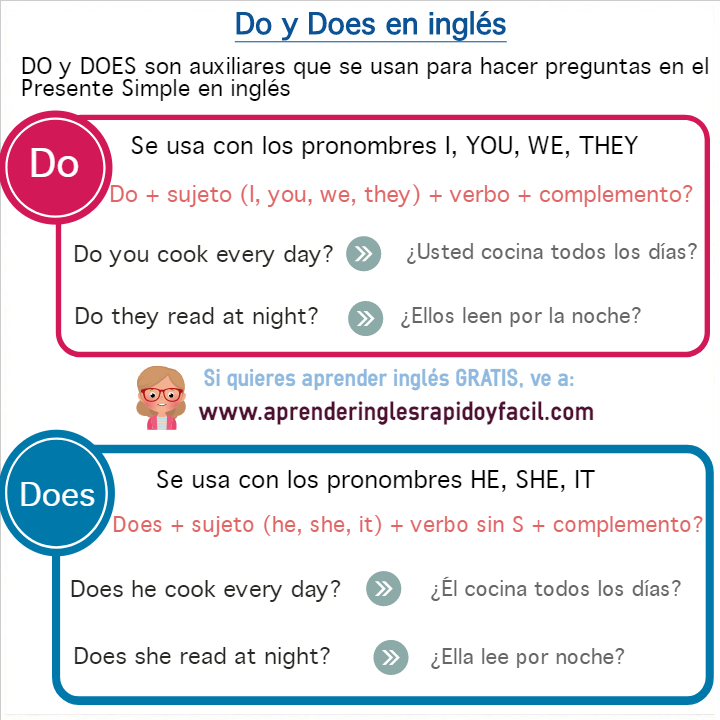
Do and Does


Do and does represent the simple present forms of the verb 'do', while did is its simple past form. They are mainly used to form negative and interrogative sentences. Do is used with personal pronouns, I, we, you, they

.


Positions in inglish

What are positions in English language?
The position of someone or something is the place where they are in relation to other things. The ship was identified, and its name and position were reported to the coastguard. This conservatory enjoys an enviable position overlooking a leafy expanse. Synonyms: location, place, point, area More Synonyms of position. 
Positional words are prepositions that dictate the relationship of nouns' positions such as 'above' or 'inside of. ' They are specific prepositions that describe a noun's relation to another noun. Positional words can also be thought of as 'location words,' as they describe the location or position of an object.


How is position determined?
We can establish the two values ​​that determine the position of a body in a plane  using a Cartesian coordinate system or a polar coordinate system as a reference . In the case of Cartesian coordinates, the distances to the two axes accompanied by the signs (+) or (-) are used.


Monday, March 18, 2024

how to make sentences

 Como en el español, la estructura más básica de una oración en inglés incluye: sujeto + verbo + complemento.

Por ejemplo:

  • Como pasta todos los días → Yo como pasta todos los días.
  • We go to school at 7am → Nosotros vamos al colegio a las 7am.


Debes recordar que esta estructura básica puede variar de acuerdo al tipo y al tiempo en el que quieras escribir la oración. Veamos los tiempos verbales más básicos:

Presente/pasado simple:  sujeto + verbo + complemento. Por ejemplo:  Quiero estudiar derecho - Anoche fuimos al cine.

Presente/pasado progresivo:  sujeto + verbo to be + verbo + complemento. Por ejemplo:  voy a ir a Londres este verano. - El tren iba a toda velocidad.

Presente/pasado perfecto:  sujeto + auxiliar have/has/had + verbo + complemento. Por ejemplo:  Ella ha estado enferma - Había hecho lo que tenía que hacer.


https://www.youtube.com/watch?v=vAdGO3Eyjw0


NEGATIVES QUESTIONS

 Negatives

We make negatives by putting not after the first part of the verb:


They are not working hard.

They will not be working hard.

They had not worked hard.

They have not been working hard.

They might not have been working hard.


In spoken English, we often reduce not to n’t:


They aren't working hard.

They won't be working hard.

They hadn't been working hard.

They haven't been working hard.

They mightn't have been working hard

 
                                                   para mayor informacion dar click aqui

HOUSE VOCABULARY

 Conocer las  partes de la casa en inglés  forma parte del aprendizaje de inglés inicial. Y es que saber el nombre de cada cosa que nos rodea es una buena forma de ir enriqueciendo nuestro vocabulario progresivamente.


  • Partes y ambientes de la casa en inglés
    Living Room (Sala de Estar): El lugar donde la familia se reúne para relajarse y socializar.
    Bedroom (Dormitorio): El espacio dedicado al descanso y al sueño.
    Kitchen (Cocina): El área donde se preparan y cocinan los alimentos.
    Bathroom (Baño): El espacio para la higiene personal y el cuidado corporal.
    Dining Room (Comedor): El área donde se comparten las comidas.
    Study/Office (Estudio/Oficina): Un espacio designado para trabajar o estudiar.
    Attic (Ático): El espacio bajo el techo, a menudo utilizado para almacenamiento.
    Basement (Sótano): El espacio debajo de la casa, a menudo utilizado como área de almacenamiento o espacio adicional.
    Floor (Planta)
    Wall (Pared)
    Roof (Techo)
    Door (Puerta)
    Chimney (Chimenea)
    Window (Ventana)


Sunday, March 17, 2024

Irregular verbs

 Irregular verbs in English represent one of the most important challenges to learn English since it is one of the indispensable grammatical elements for speaking or writing. In this article you will find basic information to understand them, such as what they are, their importance, and their rules and patterns, as well as a list of the most common irregular verbs with their different forms of conjugation.


Irregular verbs in English, which are, their importance and their use


Irregular verbs in English are those whose conjugation does not resume the ending -ed in their forms of past and past participle. For this reason, to conjugate this type of verbs it is necessary to contemplate specific rules and exceptions.


The importance of mastering irregular verbs is that there is an infinity of them, from those that are of daily use, such is the case of the verb to be, such as those of specialized uses for different professions and jobs.


It should be emphasized that irregular verbs fulfill the same functions as regular verbs, that is, to express states or actions, and are located within the sentence in the same position as regular ones.

Imagen
Para más información da clickcaqui.https://youtu.be/aNA3tQslI8A?si=hse_5Zxei0MAV4eE


What vs that vs than

 “What” significa qué o cuál y se utiliza para solicitar información sobre cosas y acciones. Debes usarlo dependiendo de la pregunta que qui...